
Is Emerald A Good Stone For An Engagement Ring?

We know that deciding upon the perfect engagement ring to pop the question to your beloved can be something of a challenge. And while we certainly don’t want to make life any more stressful for you pre-engagement, we do want to ask if you’ve considered emerald engagement rings over diamonds.
There are a few things to consider when you’re buying an engagement ring. Diamond engagement rings tend to be the go-to - and there is absolutely nothing wrong with that. But if you’d like to opt for something a little different, an emerald stone could be the way to go. Particularly if you know that your partner is a big fan of green!
Is it okay to propose with an emerald engagement ring?
We say, absolutely. You and your partner know each other well enough at this point to know what each other loves. And if you know that your significant other has a thing for emeralds, then you’re no doubt going to knock your proposal out of the park with an emerald ring!
But seriously, an emerald stone is a wonderful choice if you know that your intended loves green or isn’t the type to follow the traditional diamond route.
We also think that emerald stones in engagement rings make a gorgeous choice for anyone who has green eyes.
What does an emerald stone symbolise?
Whether you do or don’t believe in the symbolism of stones and gems, you can’t deny that it’s an interesting concept to think that these natural rocks have some kind of meaning and perhaps some natural geo-power!
So what are emerald stones supposed to symbolise? Well, depending on where you search for your information, emerald stones apparently encourage reflection, peace, growth and balance. They also represent fertility and healing.
We are not sure about all that, but we do know that if you have an emerald ring made by us it's going to have a lot of meaning attached to it.
All good stuff!
Emerald birthstone and historical meaning
Emerald has an especially interesting place in the world of gemstones. It is the birthstone for May, making an emerald engagement ring a particularly meaningful choice for someone born in that month.
Throughout history, emeralds have also been associated with ideas of renewal, fertility, love and rebirth. Emeralds have been treasured for thousands of years, with their distinctive green colour often connected with nature and new growth which makes emerald an especially fitting gemstone for a piece of jewellery celebrating the beginning of a new chapter together.
So, if you are wondering about emerald ring meaning, there is plenty of history and symbolism to explore. Of course, the most important meaning is the one you give to your own ring. Choosing an emerald because it represents a favourite colour, a birth month, a special memory or simply something your partner loves can make it all the more personal.
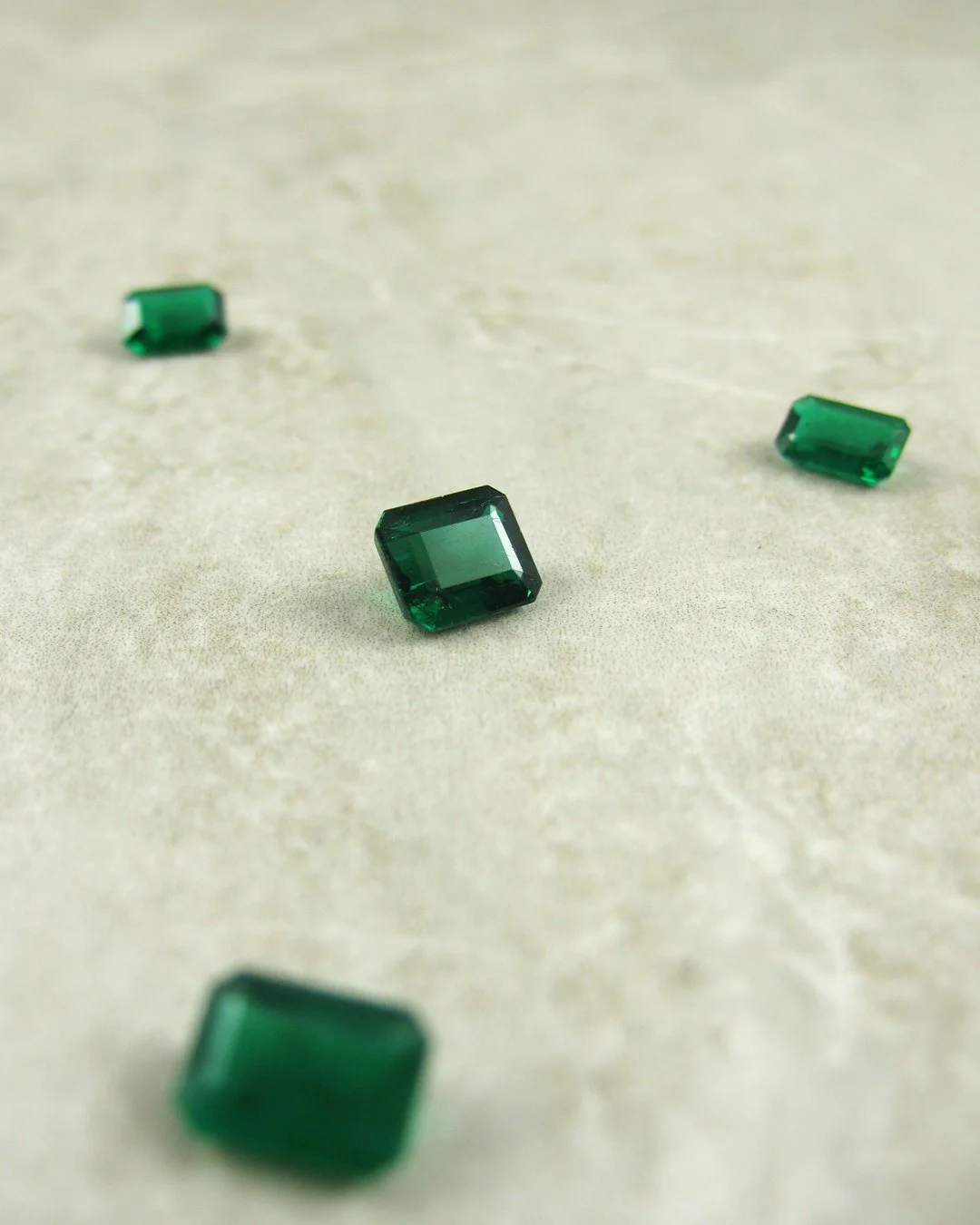
A selection of emeralds
How to identify a good emerald stone
So if you’re looking for an emerald engagement ring, and you’re going down the bespoke engagement ring route (we’re here for it!), it makes sense that you want to know how to identify a good emerald stone.
At Simon Wright, we know what makes a good emerald. A genuine emerald will display a pure green or even a bluey-green colour, and there will almost always be 'bits' (called inclusions) that you can see inside the gem. The fewer bits you can see the better… but, beware a totally clean emerald.
There are a number of synthetic emeralds on the market, and they can be too good to be true. If you find an emerald and can't see any inclusions inside the stone, then there's a good chance it's synthetic. It could also be an entirely different stone altogether!
Most emeralds you will see have been treated with oil. Oil treatment fills in big inclusions and can improve the colour of the emerald, and it's considered a perfectly acceptable practice. Natural emeralds (by natural, we mean untreated) are rarer and way more expensive.
How to choose an emerald: the 4Cs
If you are considering a natural emerald engagement ring, there are four key factors to consider when assessing the quality of the stone: colour, clarity, cut and carat.
Colour
Colour is generally the most important consideration when choosing an emerald. The most desirable emeralds tend to have a strong, vivid green colour, although the precise tone and saturation you prefer will come down to personal taste.
Some emeralds have a slightly bluish-green appearance, while others are warmer or more yellow-green. For an engagement ring, choosing a colour that you genuinely love is just as important as considering conventional ideas of rarity and value.
Clarity
This is where emeralds differ considerably from diamonds. Inclusions are extremely common in natural emeralds and are accepted as part of the character of the gemstone. These inclusions are sometimes referred to as the stone's 'jardin', from the French word for garden, because they can resemble tiny gardens within the gem. Rather than automatically indicating a poor-quality stone, inclusions can be evidence that an emerald is natural.
That does not mean that all inclusions are desirable. Large, prominent inclusions or fractures can affect an emerald's durability, so the aim is to find the right balance between clarity, appearance and overall quality. A completely inclusion-free natural emerald is exceptionally unusual, which is why it is important not to judge an emerald by diamond standards when it comes to clarity.
Cut
The cut determines how an emerald is shaped and how well it displays its colour. Emeralds are often cut in a rectangular step cut known as an emerald cut, although other shapes are possible. Because emeralds tend to have more inclusions than diamonds, the cut also needs to take the structure of the individual stone into account. A skilled cutter will work with the natural characteristics of the gem rather than simply applying a standard formula.
Carat
Carat refers to the weight of the gemstone rather than its quality. As with other gemstones, a larger emerald will generally be more expensive, but two emeralds of the same carat weight can have very different values depending on their colour, clarity, origin and overall quality. When considering how to choose an emerald, it is therefore worth looking at the whole stone rather than focusing solely on its size.
Why are inclusions normal in natural emeralds?
If you are used to looking at diamonds, you might initially wonder why an emerald contains visible inclusions. With emeralds, these internal characteristics are a normal part of the gemstone. Natural emeralds form under complex geological conditions, and the inclusions they develop can help tell the story of their formation. They can also distinguish a natural emerald from a laboratory-grown or heavily treated stone.
For this reason, an emerald with some visible inclusions can still be a beautiful and valuable gemstone. Rather than searching for an emerald that is completely flawless, it is better to look for a stone whose inclusions do not detract from its colour, beauty or structural integrity.
Emerald vs Diamond and Sapphire Engagement Rings
If you are considering an emerald, it can be helpful to compare it with the two gemstones most commonly associated with engagement rings: diamond and sapphire.
An emerald vs diamond engagement ring comparison highlights an important difference in durability. Diamond is the hardest natural mineral, while sapphire is also exceptionally hard. Emerald is softer and more susceptible to scratching and damage, so it needs a little more care.
In terms of appearance, however, emerald offers something neither diamond nor sapphire quite replicates. Its rich green colour creates an immediate focal point, whereas diamonds are prized for their brilliance and sapphires offer a much wider range of colours, including blue, pink and green.
An emerald vs sapphire engagement ring can therefore come down largely to colour and personal style. Both offer beautiful alternatives to diamond, but an emerald's vivid green has a particularly distinctive character.
Cost can also vary significantly between all three gemstones. Diamonds can command high prices depending on their size and quality, while sapphire offers a broad range of price points. Emerald prices can vary considerably depending on colour, clarity, origin, treatment and whether the stone is natural or laboratory-grown.
Ultimately, there are emerald engagement ring pros and cons to consider, just as there are with any gemstone. Emerald offers exceptional beauty, colour and individuality, but its relative softness means it requires more care than diamond or sapphire.
How durable are emerald engagement rings?
If you are wondering how durable emerald engagement rings are, the short answer is that they can be suitable for everyday wear, but they require more care than diamond or sapphire rings. Emerald is relatively softer and its characteristic inclusions can make it more vulnerable to damage. This doesn't mean you cannot wear an emerald engagement ring every day. It simply means that it is sensible to take extra care when wearing one.
The setting is also important. A well-designed bespoke ring can be created with the characteristics of the individual emerald in mind, helping to protect the stone while showcasing its colour.
For anyone considering a bespoke emerald engagement ring, this is one of the advantages of working directly with a jeweller. The design can be tailored around the gemstone rather than choosing a setting first and trying to find a suitable emerald afterwards.
Emerald Engagement Ring Care
Because emerald is a little more delicate than diamond or sapphire, looking after your ring properly is particularly important.
How to clean an emerald engagement ring
For regular emerald engagement ring care, gently clean the ring using lukewarm water, a soft cloth and, if necessary, a small amount of mild soap. Avoid vigorous scrubbing and never use an abrasive cleaner.
Ultrasonic and steam cleaners should generally be avoided with emeralds, particularly where the stone has been treated or contains significant inclusions. Heat and vibration can potentially damage the gemstone or affect treatments such as oil filling.
When in doubt, professional cleaning by an experienced jeweller is the safest option.
How to protect an emerald engagement ring
It is also sensible to remove an emerald engagement ring before activities where it could be knocked, scratched or exposed to chemicals - this includes sports, DIY, and heavy gardening.
Store your ring separately from harder gemstones such as diamonds, as these can scratch the emerald if the pieces come into contact.
Regular professional checks are also a good idea. A jeweller can inspect the setting, claws and gemstone to make sure everything remains secure.
Emerald Engagement Ring FAQs
Are emeralds durable enough for an engagement ring?
Yes, emeralds can be used for engagement rings, but they require more care than harder gemstones such as diamond and sapphire. Their inclusions and relative softness mean that they are more vulnerable to scratches, knocks and damage. A protective setting and sensible everyday care can help keep an emerald engagement ring looking beautiful.
How should I care for an emerald engagement ring?
Gently clean your emerald with lukewarm water, mild soap and a soft cloth. Avoid ultrasonic and steam cleaning, harsh chemicals and abrasive materials. It is also advisable to remove your ring for activities where the gemstone could be knocked or scratched.
Are natural emeralds better than lab-grown emeralds?
Natural and laboratory-grown emeralds are both genuine emeralds, but they have different origins. Natural emeralds form naturally within the earth, while laboratory-grown emeralds are created under controlled conditions.
Natural emeralds are generally rarer and can command higher prices, particularly when they have desirable colour, clarity and provenance. Laboratory-grown emeralds can provide an alternative for those who are more focused on appearance and budget.
Are emerald engagement rings expensive?
The cost of an emerald engagement ring can vary significantly. Factors including colour, clarity, carat weight, origin, treatment and whether the emerald is natural or laboratory-grown can all influence the price.
A particularly fine natural emerald can be extremely valuable, while other emeralds can provide a more accessible alternative. The overall cost of the ring will also depend on the metal, setting, diamonds and complexity of the design.
Is an emerald engagement ring a good alternative to diamond?
For someone who wants a colourful and distinctive green gemstone engagement ring, emerald can be a wonderful alternative to diamond. It has a unique appearance and considerable historical appeal. However, emerald is less durable than diamond, so it is important to understand the care involved before choosing one for everyday wear.
Emerald stone engagement rings at Simon Wright
At Simon Wright, we know how to create a bespoke engagement ring. And we know that although diamonds are stunning, not all engagement rings need to feature that particular stone.
Emerald engagement rings can make a beautiful and unique ring to propose to your partner with and will be especially meaningful if they have a connection to the stone.
Maybe they love green, maybe they have green eyes, or maybe they were born in the month of May - emerald’s birthstone month. Whatever the reason, if you’re wondering what an emerald stone symbolises, we say it can mean anything you want it to.
Creating an emerald engagement ring - or any kind of ring - at Simon Wright will make your engagement that much more special. And Simon will work with you personally to make sure that the ring you design is the perfect symbol of your love.
Want to know how to identify a good emerald stone? Want to design the most stunning engagement ring that will delight your fiance-to-be?
Get in touch with us here at Simon Wright and discover the beauty of emerald engagement rings and bespoke jewellery in London to make your proposal truly one of a kind.

Simon Wright is a highly respected jeweller whose precision, artistry, and dedication to craftsmanship have defined his career for over three decades. Known for his meticulous attention to detail and ability to create meaningful, exquisitely made pieces, he has earned recognition not only from clients but also within the wider industry. Simon has contributed to the prestigious Goldsmiths’ Craftsmanship & Design Awards as a judge, supporting innovation in design, and has trained apprentices who have gone on to build successful careers, cementing his reputation as both a master craftsman and a mentor within the luxury jewellery world.
Contact us today to
schedule an appointment
Start your bespoke engagement ring journey today